




Free Resources & Insights
Access free tools, videos and resources to help you understand your options and take action.
Free Resources & Insights
Access free tools, videos and resources to help you understand your options and take action.
A Central Resource for Knowledge, Action, and Clarity
Curated by Attorney Eric Esteban Cardenas
Legal problems are hard enough without having to guess what to do next.
This Resource Hub is here to help you understand your rights, learn what information may matter, and take the next step with more confidence. Whether your issue involves a serious injury, a dangerous product, a mass tort claim, or an immigration matter, these resources are designed to give you clear, practical guidance before you make an important decision.
Here, you will find blog articles, step-by-step guides, case updates, legal explainers, and helpful content from Eric Cardenas LAW across Facebook, Instagram, YouTube, and TikTok.
You can also use our case review tools to help organize what happened, identify records that may be important, and understand whether your situation may need further legal review.
The goal is simple: help you stop guessing.
These resources are not a substitute for legal advice, and reading them does not create an attorney-client relationship. But they can help you better understand your options, avoid common mistakes, and prepare for a more useful conversation with a legal team.
I will continue expanding this hub with more guides, videos, and answers to common legal questions. If there is a topic you would like me to cover, please let me know.
Start here. Learn what matters. Then take the next step with confidence.
The Blog
Deep Dives, Investigations, Step-By-Step Guides, and Articles.
Why a Jury Took Social Media Addiction Seriously — And Why That Matters
Social media addiction lawsuit updates, injuries, and if you have a case by attorney Eric Cardenas.
CONTACT ERIC CARDENAS LAW TODAY

After a recent social media addiction verdict, many people online reacted the same way:
“Everyone is addicted.”
“How do I get my check?”
“This is the parents’ fault.”
But those reactions are based on headlines — not the actual facts presented at trial.
Understanding what the jury was asked to decide, and what they ultimately found, is critical to understanding why this verdict matters.
What the Case Was Actually About
This case was not about someone claiming, “I use Instagram too much, so I should get paid.”
It was about a young woman, Kaley — also known as K.G.M. — who testified that her social media use began at a very young age. According to her testimony, she started using YouTube at age 6 and Instagram at age 9. Over time, her use became compulsive.
She described how that use affected her life in serious ways. She testified that social media left her:
anxious and depressed,
insecure about her appearance,
unable to put her phone down,
losing sleep,
struggling in school, and
withdrawing from real-life relationships.
She also testified that she experienced suicidal thoughts and began self-harming at age 10.
Her treating therapist later diagnosed her with social phobia and body dysmorphic disorder and testified that social media was a contributing factor to her mental health issues.
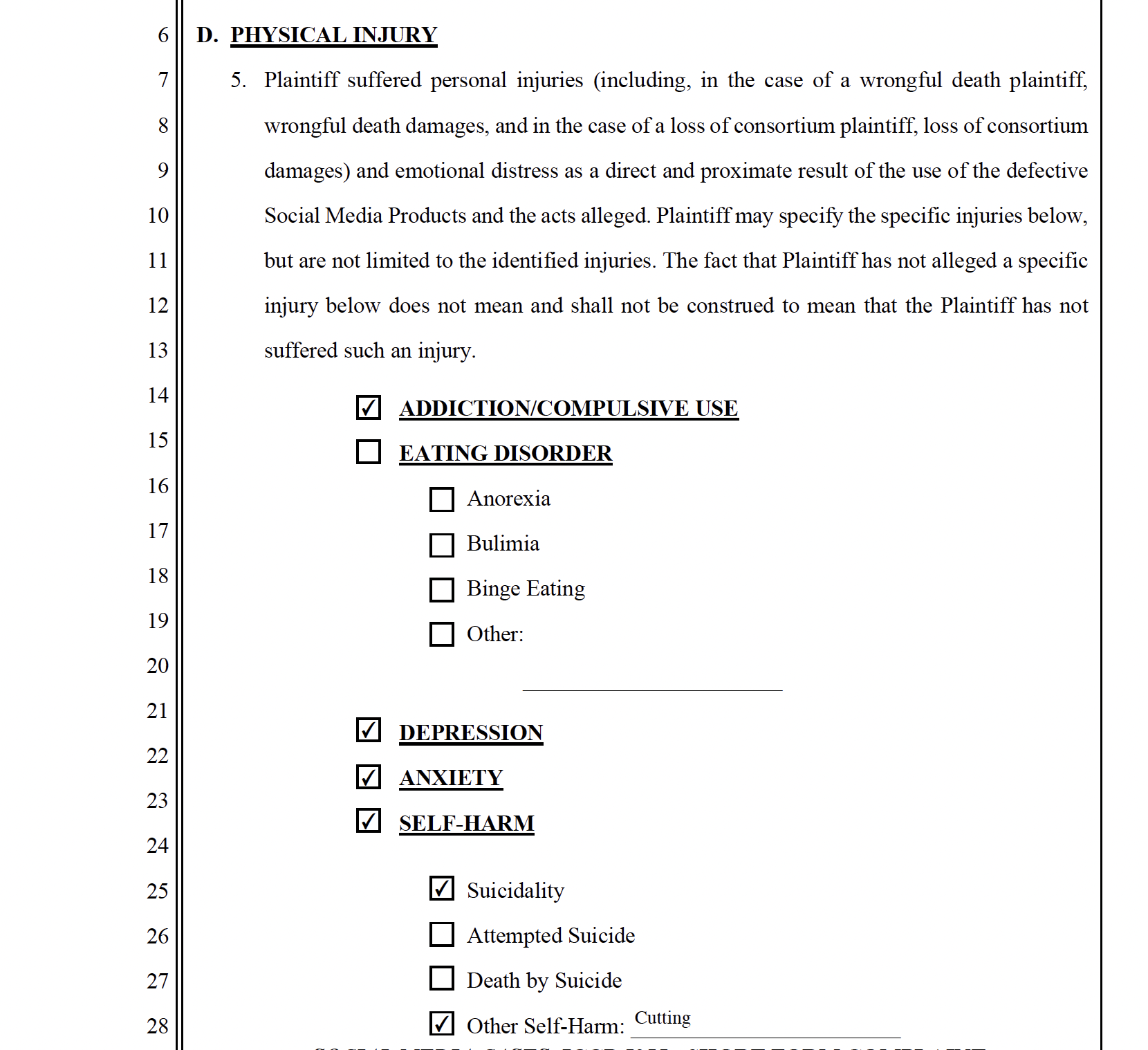
Complaint excerpt from Kaley social media addiction lawsuit listing alleged injuries such as depression, anxiety, and self-harm (cutting).
What the Jury Was Asked to Decide
In cases like this, the jury is not deciding whether people spend too much time on their phones. The legal questions are far more specific.
The jury was asked to determine whether a company designed or operated its product in a way that created danger, whether it knew or should have known about that danger, and whether that conduct caused harm.
After hearing the evidence, the jury made several key findings about Meta’s role in the design and operation of Instagram.
What the Jury Actually Found
The jury found that Meta was negligent in the design or operation of Instagram.
They found that Meta knew, or reasonably should have known, that the platform’s design was dangerous when used by minors in a foreseeable way.
They also found that children using the platform would not recognize those dangers on their own.
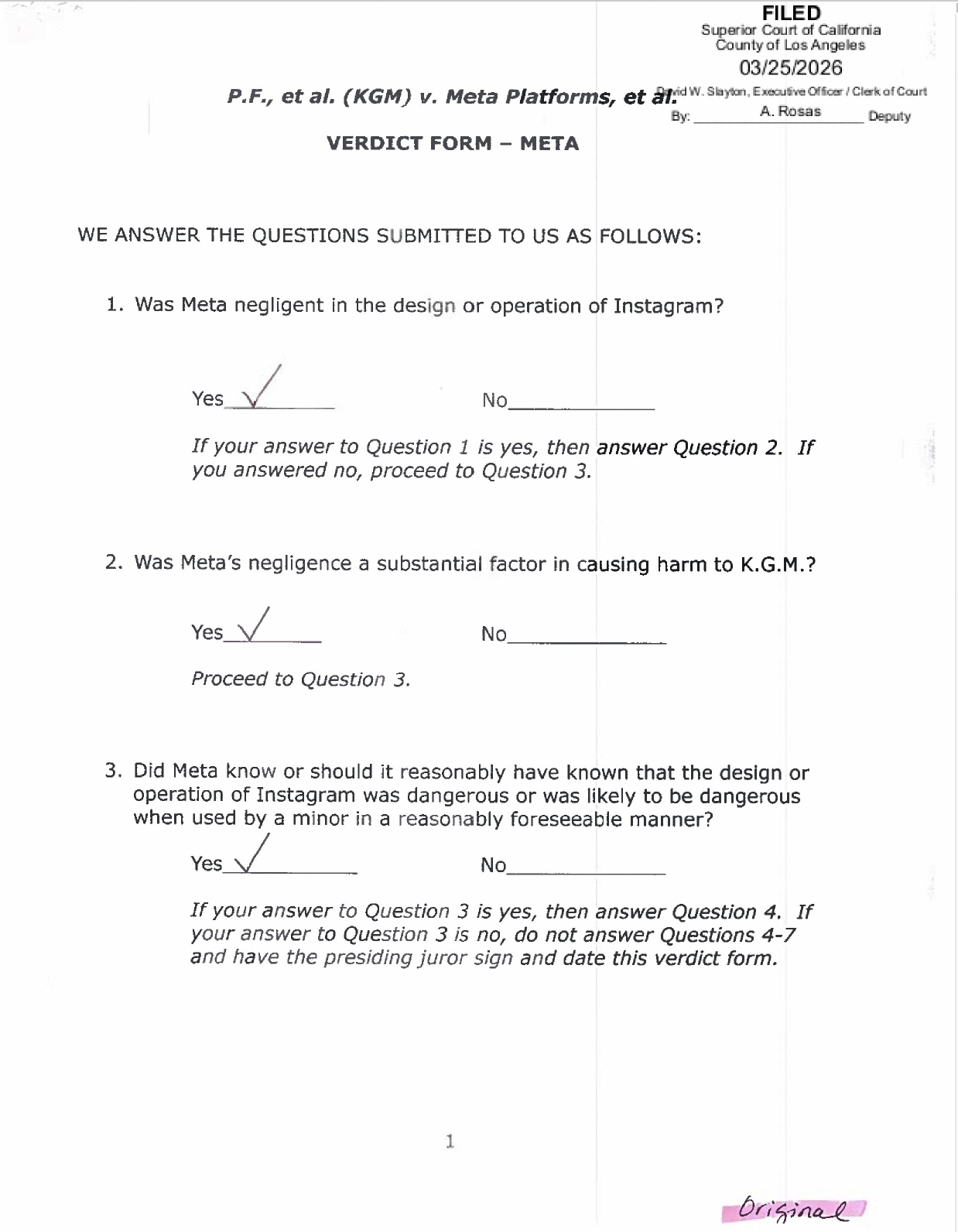
Jury verdict form finding Meta negligent in social media addiction lawsuit involving Instagram design.
The jury further concluded that Meta failed to adequately warn users about those risks, and that a reasonable company under similar circumstances would have provided warnings or instructions about safe use.
Most importantly, the jury found that both Meta’s negligence and its failure to warn were substantial factors in causing harm to Kaley.
These findings are the result of a weeks long trial, based on evidence, testimony, and legal standards applied by the jury.
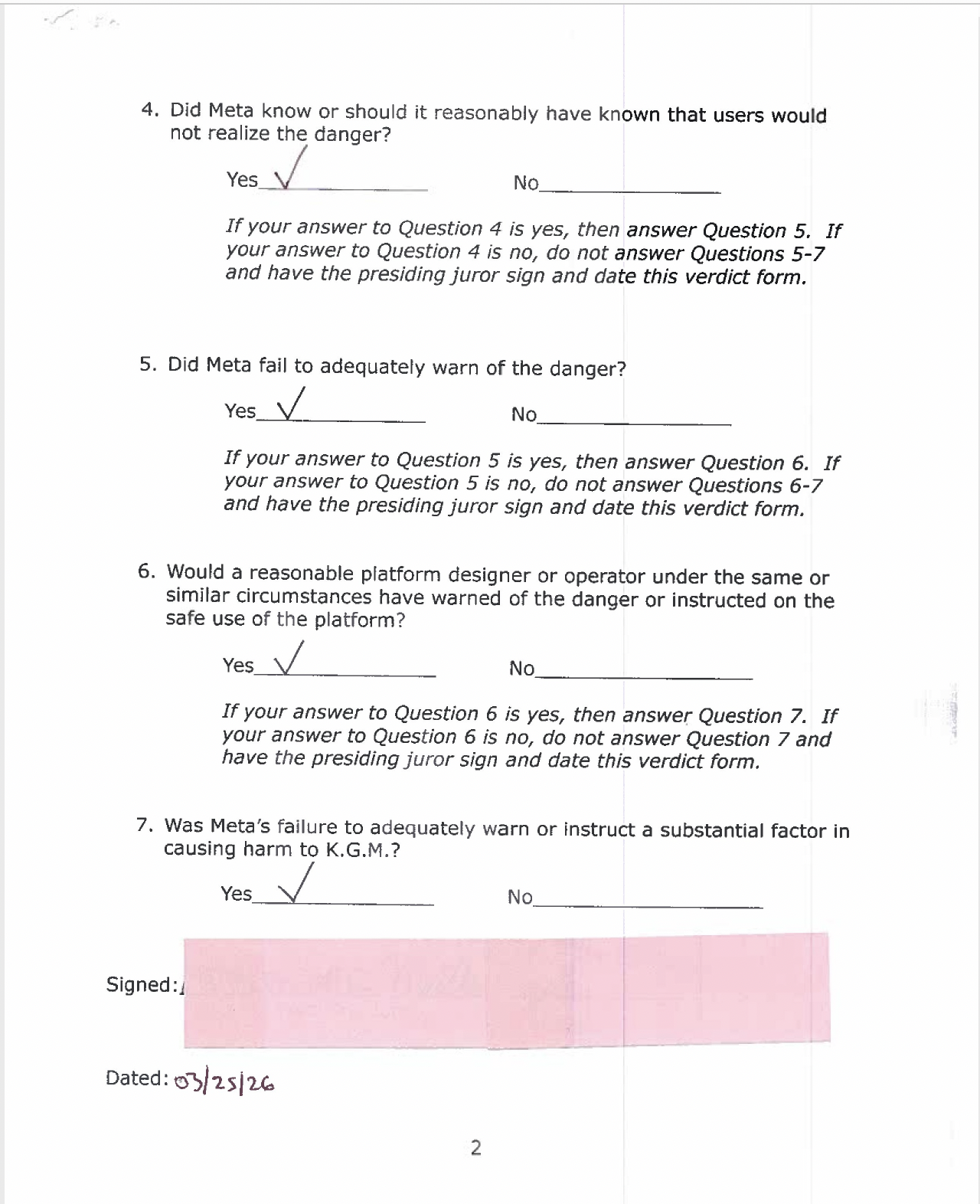
Jury verdict form page 2 finding Meta negligent in social media addiction lawsuit involving Instagram design dated March 25, 2026.
The Damages Awarded
Based on those findings, the jury awarded:
$3 million in compensatory damages for Kaley’s injuries, and
$3 million in punitive damages.
Compensatory damages are intended to account for the harm suffered.
Punitive damages serve a different purpose. They are meant to punish and deter conduct when a jury finds that a company’s actions rise to a higher level of wrongdoing.
Why This Distinction Matters
A common reaction to this case is: “Everyone uses social media.”
That may be true.
But the legal issue was not whether social media is widely used. The issue was whether, in this case, its design and operation contributed to serious, documented harm.
There is a difference between ordinary use and injury.
There is a difference between habit and compulsion.
And there is a difference between inconvenience and conditions like depression, self-harm, suicidal thoughts, and diagnosable mental health disorders.
This case falls into the latter category.
Moving Forward
Before forming an opinion about cases like this, it is important to understand what was actually proven.
This verdict was not about casual use of social media. It was about whether a product, designed in a particular way, contributed to significant harm that began in childhood and continued into later life.
If Kaley’s story sounds similar to your own, or to someone you know, it may be worth taking a closer look.
A proper evaluation involves reviewing when the use began, what injuries occurred, what treatment was received, and what evidence exists to support those facts.
If you would like your situation reviewed, you can send over your information. You will receive a clear assessment of whether your facts may support a claim, along with a roadmap created by attorney Eric Cardenas about what steps to take next.
And if your situation is better suited for another attorney or another path, you will be pointed in the right direction.
Understanding your options is the first step toward protecting your rights.

The Social Media Channels
Find us on Instagram, Facebook, TikTok, YouTube, and LinkedIn.
TikTok
YouTube


Copyright 2026 | Eric Cardenas LAW, PLLC